
INTRODUCTION
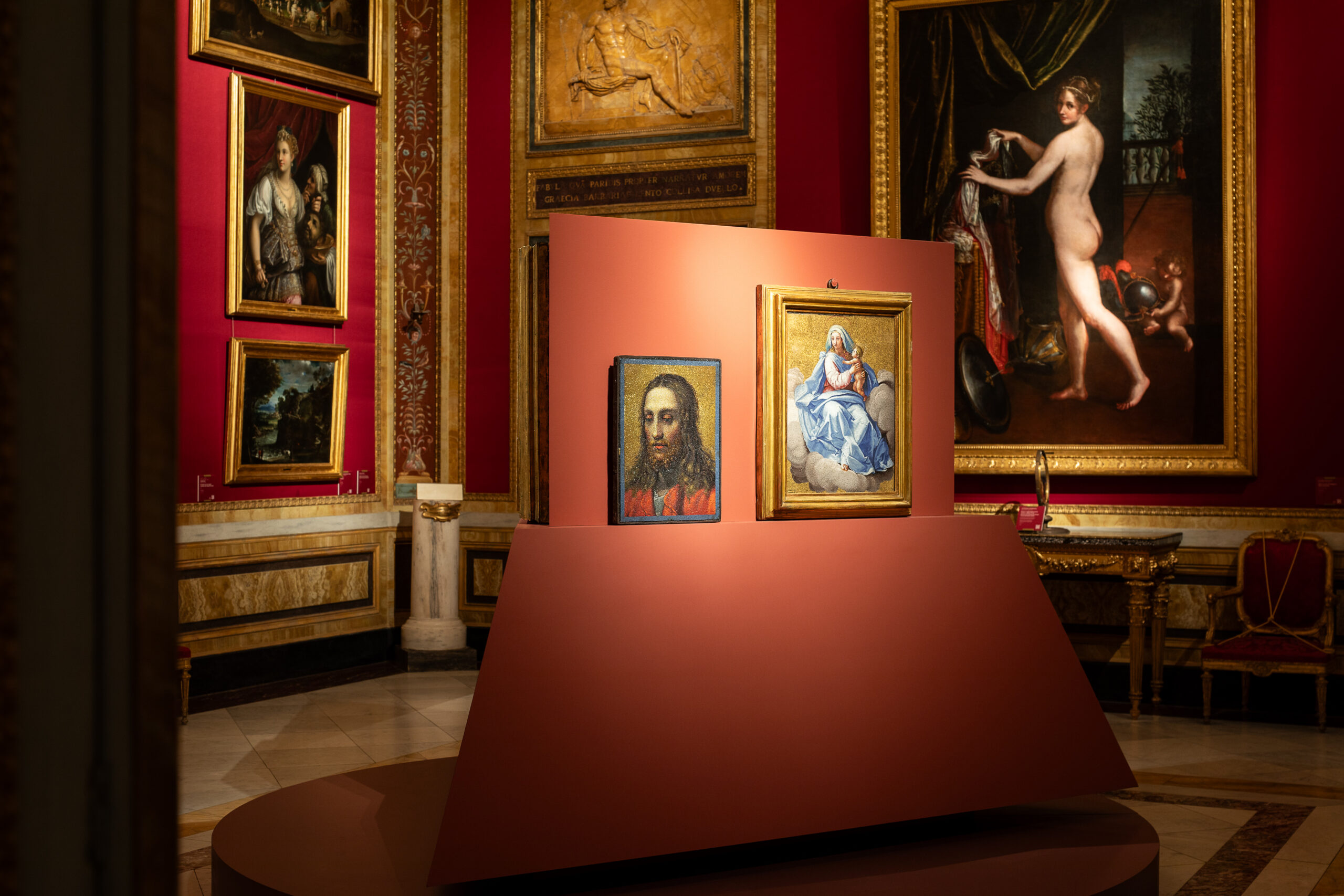
On the occasion of the 450th anniversary of his birth, the Galleria Borghese presents an exhibition dedicated to Marcello Provenzale, a leading figure in the revival of mosaic art in Rome between the sixteenth and seventeenth centuries. His career was profoundly shaped by his relationship with the Borghese family, who recognized his talent and established him as their trusted artist, a bond that endured throughout his life. Provenzale died on June 4, 1639, in the Palazzo Borghese in Campo Marzio.
For Pope Paul V and his nephew Scipione, alongside his work in the Vatican Basilica, he executed refined small-scale easel mosaics for the private collection, including Madonna and Child, Orpheus, and the Portrait of Paul V. These works attest to the popularity of mosaic as a collectible art form in the early seventeenth century. Particularly emblematic is the Owl with Birds, gifted in 1631 by Scipione to Grand Duke Ferdinando II de’ Medici, while the Portrait of Paul V translates the idea of eternity into mosaic form, rendering the pontiff’s features in glass tesserae as an enduring image of the family’s power.
Born in Cento in 1576 and soon specializing in mosaic art in Rome, Marcello Provenzale worked within the Counter-Reformation climate of the late sixteenth century, a period that saw the ancient art of mosaic experience a renewed flourishing in the city. Its use in the Gregorian Chapel of Saint Peter (1578–1580) was not only a tribute to Christian antiquity but also a highly symbolic gesture: mosaic, which Giorgio Vasari had defined as “painting for eternity,” became the visual language of the renewed Church. Active at Saint Peter’s from 1600 onward, Provenzale contributed to the decoration of the Clementine Chapel and the dome. Pope Paul V entrusted him with other prestigious commissions, including the Borghese coat of arms in the basilica nave (1614) and the restoration of Giotto’s Navicella (1617–1618).
Provenzale’s name soon became associated with a new conception of mosaic art: Ottavio Leoni called him inventor novi modi conficiendi opus musivum, while in a 1616 chirograph, Paul V praised him for “a new way of making mosaics, very different and more beautiful than the ancient.” His technique of mosaico filato, based on drawing glass enamel into thin rods, allowed Provenzale to achieve chromatic gradations of extraordinary subtlety, rivaling the finesse of painting itself.