Towards the exhibition “Metamorphoses. Ovid and the Arts”- Part 2
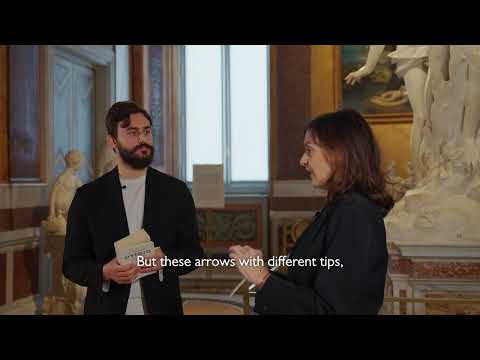
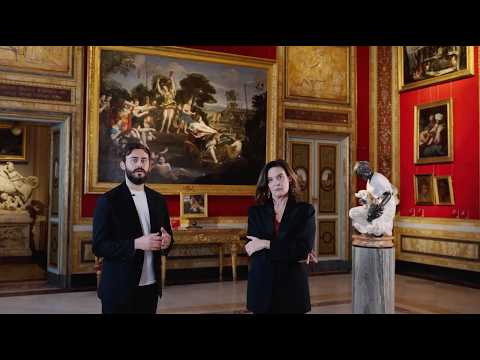
Francesca Cappelletti, director of the Galleria Borghese, and Claudio Sagliocco, a young scholar, continue their dialogue with Ovid in preparation for the exhibition “Metamorphoses. Ovid and the Arts,” which will be on view at Galleria Borghese from June 23 to September 20, 2026. At the origin of the story of Apollo and Daphne, as told by Ovid in the “Metamorphoses”, there is not chance but conflict: that between the god of the sun and Cupid. Proud of having defeated the monstrous Python, an embodiment of primordial chaos threatening the order of the world, Apollo mocks the young god of love, failing to recognize the destabilizing force he represents. It is a fatal mistake: in Ovid, love is a power capable of overturning hierarchies, certainties, and identities. In revenge, Cupid releases two contrasting arrows: the golden one, which ignites irresistible desire, strikes Apollo; the leaden one, which produces rejection and aversion, pierces Daphne. From this imbalance arises one of the most dramatic dynamics in mythology: an unrequited love that turns into pursuit. Daphne is a radical figure: free, opposed to marriage, devoted to a wild and autonomous life, akin to that of Diana. Apollo, by contrast, is overwhelmed by a growing passion. He falls in love not only with Daphne’s beauty, but with her movement: her running, the wind that tousles her hair, the very inaccessibility that fuels his desire. In Ovid, beauty is never static; it emerges and intensifies through motion, distance, and the very act of fleeing. This is precisely the principle that finds extraordinary visual expression in the Baroque sculpture of Gian Lorenzo Bernini, who transforms marble into gesture, tension, and metamorphosis. The pursuit, however, shifts in tone: from courtship it becomes a hunt. Apollo persists, speaks, tries to reassure her, yet Daphne senses the threat. Like prey, she flees until she realizes that her only salvation lies in renouncing herself. She asks to be transformed: her body stiffens, her skin turns to bark, her feet take root in the earth. She becomes a laurel tree. Metamorphosis is both salvation and loss. Daphne preserves her integrity only by abandoning her human form and her beauty, the very source of the desire that pursued her. Apollo, arriving too late, can only embrace the trunk and feel, beneath the bark, a lingering pulse of life.
Subscribe to Galleria Borghese newsletter to stay updated on all the latest museum news!
Manage Cookie Consent
To provide the best experiences, we use technologies like cookies to store and/or access device information. Consenting to these technologies will allow us to process data such as browsing behaviour or unique IDs on this site. Not consenting or withdrawing consent, may adversely affect certain features and functions.
Functional
Always active
The technical storage or access is strictly necessary for the legitimate purpose of enabling the use of a specific service explicitly requested by the subscriber or user, or for the sole purpose of carrying out the transmission of a communication over an electronic communications network.
Preferences
The technical storage or access is necessary for the legitimate purpose of storing preferences that are not requested by the subscriber or user.
Statistics
The technical storage or access that is used exclusively for statistical purposes.The technical storage or access that is used exclusively for anonymous statistical purposes. Without a subpoena, voluntary compliance on the part of your Internet Service Provider, or additional records from a third party, information stored or retrieved for this purpose alone cannot usually be used to identify you.
Marketing
The technical storage or access is required to create user profiles to send advertising, or to track the user on a website or across several websites for similar marketing purposes.