

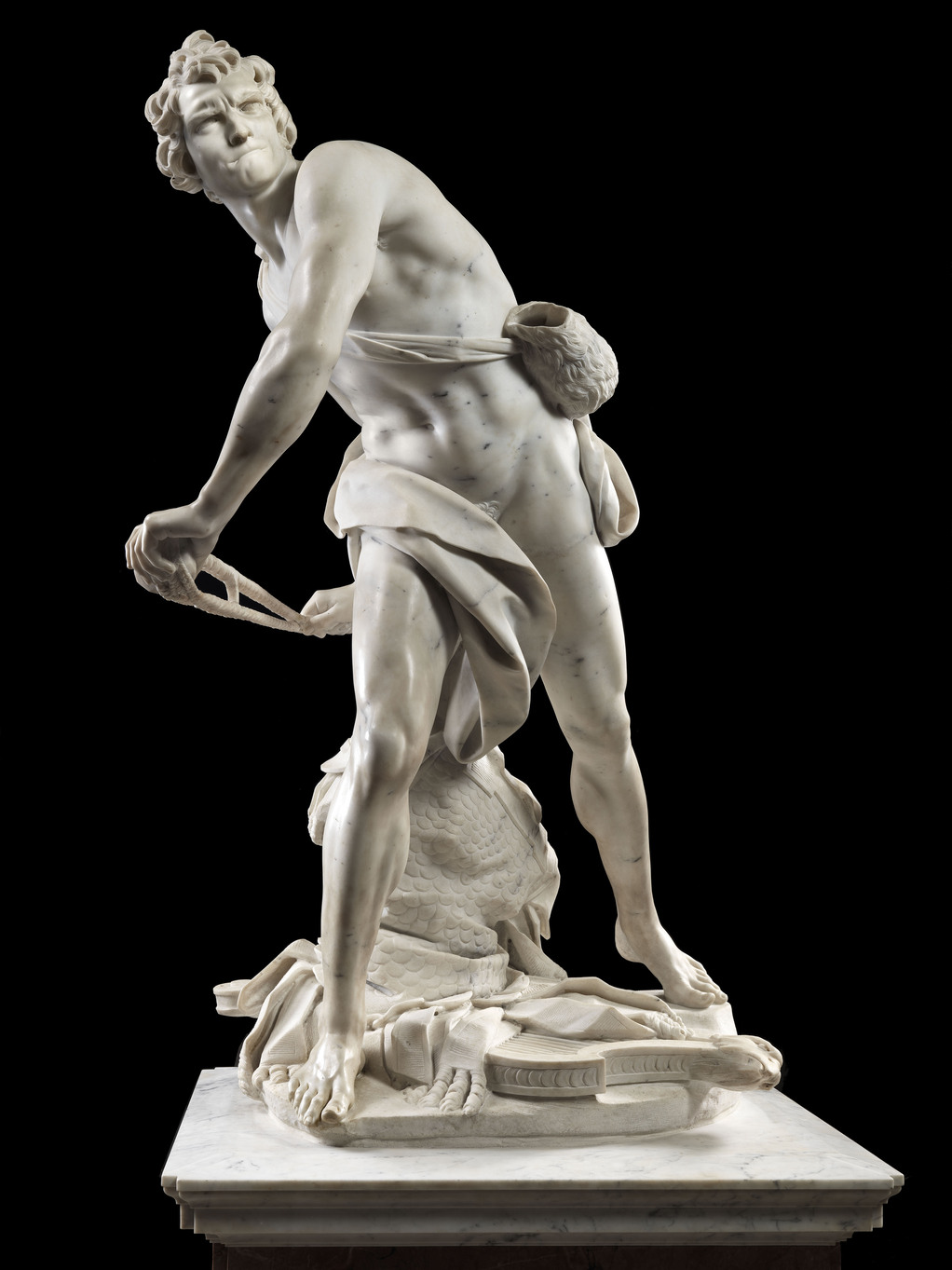
This sculpture comprises the only biblical subject that the young Gian Lorenzo Bernini created for Scipione Borghese. It depicts David just before he launches the stone that would strike the giant Goliath, who had been summoned by the Philistines to fight the Israelite army. At his feet lies the breastplate given to him by King Saul, along with a zither. The instrument, a traditional attribute of the Old Testament hero, here displays the head of an eagle. This significant ornamentation clearly refers to the Borghese family, as evidence of their patronage and celebrated status. The pontificate of Gregory XV Ludovisi had been unfavorable to the Borghese, and upon its end in July 1623 the family hoped to restore their former glory. Devoting himself to this sculpture required Bernini to halt his work on Apollo and Daphne and he managed to finish it in only seven months. The sculpture originally stood against a wall, as indicated by its unfinished back. Part of the left heel was also incomplete, though modern restorers later finished it. Bernini intended the sculpture to have only one vantage point, a compositional principle that persisted throughout his oeuvre. Here, the ideal viewpoint lies at the central axis between the figure and the viewer’s eye. This, along with the original base, smaller than the current one, would have facilitated spectators’ involvement in the unfolding drama. Standing where Bernini intended, viewers would find themselves exactly where Goliath stood, a point from which they could experience maximum emotional engagement while visualizing the stone hurtling towards them through the air. Contemporary sources report that Bernini sculpted his own features in David’s face. The seventeenth-century author Filippo Baldinucci recounts that Cardinal Maffeo Barberini – who would soon become Pope Urban VIII – delighted in helping the artist by holding up a mirror to his face as he worked. The sculptor’s self-identification with the biblical hero is rife with meaning. Bernini imagines himself as a wrestler battling this block of stone, transforming it into flesh, sinew, muscle, and rope. He further confronts the inescapable shadow of Michelangelo’s David, the famous sixteenth-century sculpture that depicted the hero in a traditional, balanced posture as he prepares to face his enemy. Portraying David in mid-action with a twisting body about to strike, Bernini radically altered this iconography and created one of the most intense masterpieces of his entire career.
Learn more:
https://www.collezionegalleriaborghese.it/en/opere/david