
THE POWER OF LOVE VENUS, CUPID AND NARCISSUS
In the Metamorphoses, love is a force capable of governing men, gods and nature. It can generate beauty, life and desire, but also deception, pain and destruction. Many of Ovid’s tales of metamorphoses are the repercussions of a passionate love affair: of love pursued and unrequited, impossible desire, jealousy or loss.
Cupid embodies this unpredictable force, while Venus, goddess of love and beauty, represents the ambiguous power of Eros, celebrated in the works of Titian (c.1489–1576), Sacred and Profane Love and Venus Blindfolding Cupid, where love is both an earthly impulse and a spiritual tension.
The myth of Narcissus takes this re ection on desire to its most tragic conclusion. Ovid tells of an extraordinarily beautiful young man who is incapable of returning the love of others. The nymph Echo wastes away for him, rejected until she is reduced to nothing but a voice; Narcissus, seeing his own image re ected in the water, and not recognising himself, falls hopelessly in love with it. Unable to reach that apparition, he gives in to death and is transformed into the ower that bears his name.
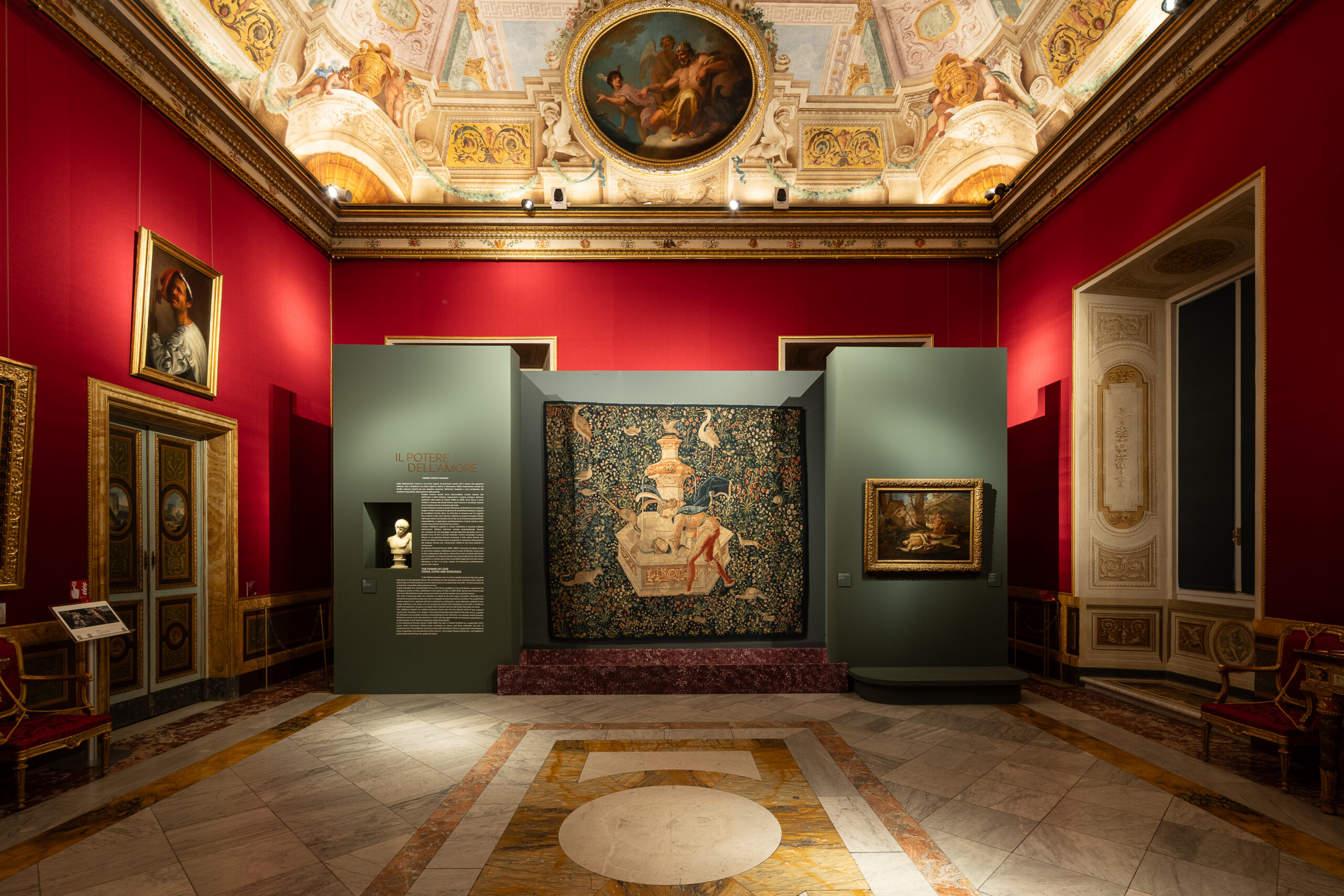
The mille eurs tapestry on exhibit transposes Ovid’s tale into the re ned world of late medieval courtly love. Narcissus is no longer in the natural landscape described by the poet, but in a garden full of owers and symbolic animals, contemplating his own re ection in an opulent marble fountain. While the ancient myth also becomes a moral warning against pride and excessive attachment to earthly beauty, it still retains its seductive melancholic power.
In the painting by Nicolas Poussin (1594–1665), the tale is instead rendered as a suspended, silent scene, where Narcissus’s lifeless body surrenders to nature, and Echo embodies the pain of unrequited love. The exhibition comes to a close with the theme of love as a generative yet dangerous force, inseparable from the elements of the cosmos – from water, owers and the sky – and capable of profoundly transforming men, gods and nature.