
ARACHNE: WEAVING STORIES
In Book VI of Metamorphoses, Ovid tells the story of Arachne, a young weaver from Lydia, famous for her extraordinary skill. The girl is proud of her talent, and dares to challenge Minerva to a weaving contest. While the goddess depicts the power of the gods and punishments in icted upon mortals, Arachne chooses to represent the deceptions and metamorphoses employed by the gods to seduce men and women. Her tapestry is so perfect that it enrages Minerva. Unable to nd any aws in it, the goddess destroys the young woman’s work and turns her into a spider, condemning her to spin for all eternity.
In Ovid’s tale, weaving becomes a metaphor for poetic creation and how art can transform words into images. Tintoretto (1518–1594) interpreted the myth by depicting the act of weaving itself: Arachne works at the loom under Minerva’s pensive gaze. The scene celebrates intellectual imagination and artistic practice. In the painting from the Prado, Rubens (1577–1640) instead focuses on the moment of punishment, when the goddess strikes Arachne after contemplating her tapestry depicting the Rape of Europa.
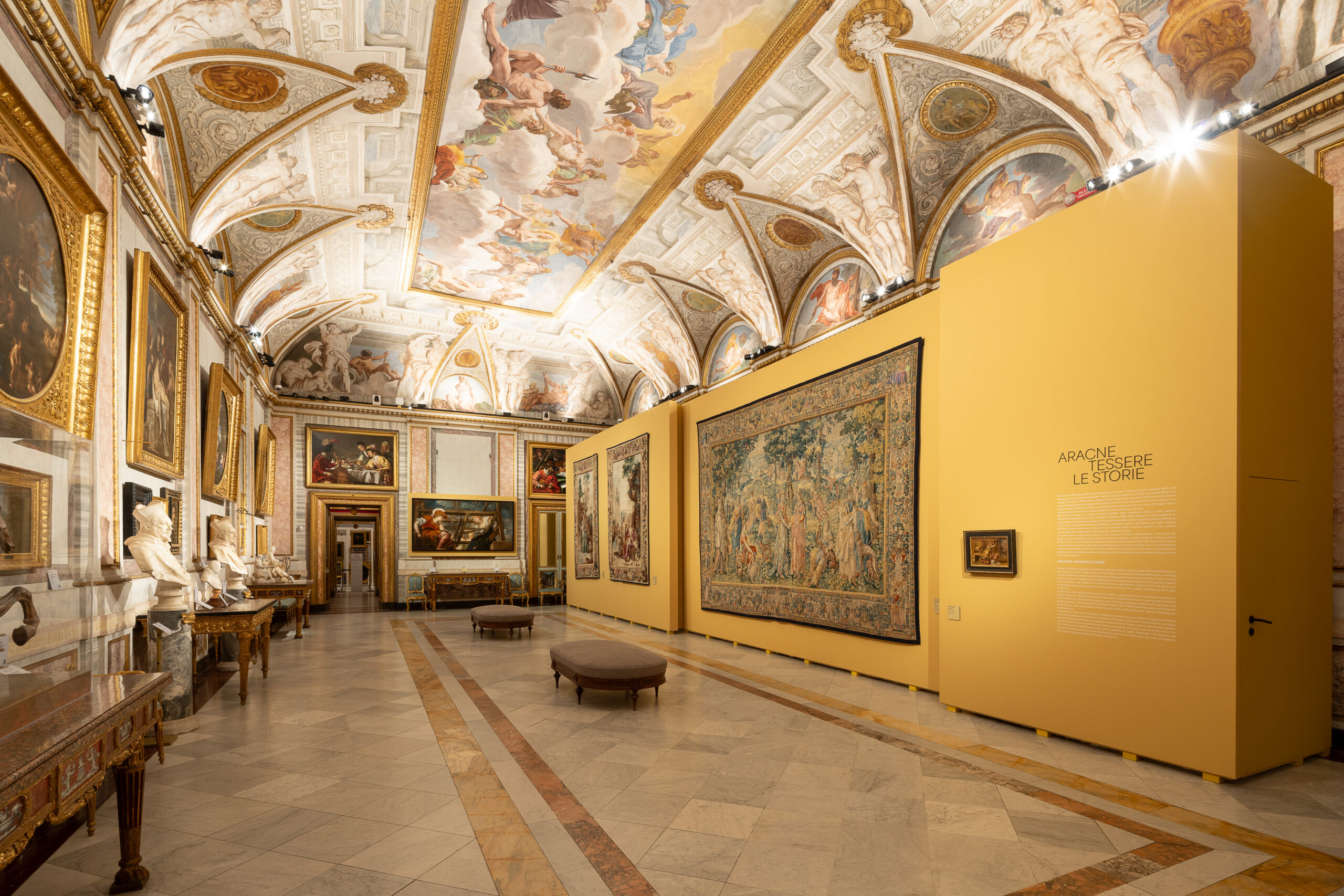
In this section, Ovid’s verses are given a visible form, transforming the myths into tapestries, thereby reversing the ekphrasis of Ovid’s tale. The stories of Bacchus and Ariadne, Pan and Syrinx, and Diana and Procris translate the poem into precious textile surfaces. Threads replace colourful descriptions and the narrative is constructed through interwoven episodes and continuous visual references. The myth of Arachne inevitably leads to the amorous exploits of Jupiter illustrated in her tapestry and naturally introduces the next section dedicated to Leda and the Swan. Here, the myth is brought to life through sculpture, painting and artistic imagination.