
La seconda lingua degli italiani
Leda and the Swan: a sculpture between myth and history – Massimo Osanna
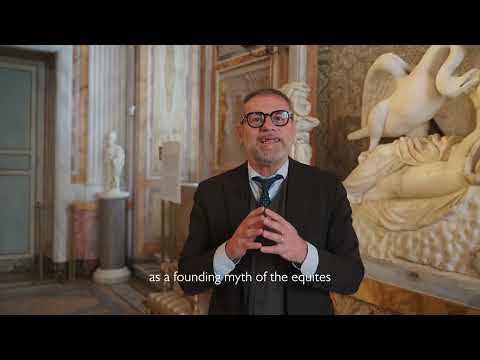
n the celebrated Room of Pauline Bonaparte, among the numerous statues exalting beauty and sensuality, lies a profoundly interesting Roman work from the 3rd century AD: “The group of Leda with the Swan and Eros”.
This is the myth of Leda, a tale that spans centuries and continues to provoke reflection. Massimo Osanna, Head of the Department for Cultural Activities, explains that although late 18th-century restorations altered its original appearance, the essence of the work remains intact: the moment the beautiful princess welcomes the swan. Yet, hidden behind the elegance of that creature is Zeus, the master of transformation, who tenaciously seeks to win the heart of Tyndareus’ bride.
Zeus transforms into a swan to seduce Leda, the Queen of Sparta. Feigning an escape from an eagle’s attack, the god finds refuge in the woman’s bosom. From this union, an egg is born, giving life to the Dioscuri, the fateful Helen, and the tragic Clytemnestra. It is a fundamental mythological core that serves as an encyclopedia of human behavior: love and violence, loyalty and betrayal, leading up to the premise of the Trojan War.
The work we admire today is a fascinating historical mosaic. Scientific study of the materials reveals that the head is made of Luni marble from the Julio-Claudian era, likely depicting Antonia Minor, mother of the Emperor Claudius. The body, however, is sculpted from Greek Parian marble dating to the 2nd century AD, reclining on a rock to evoke the banks of the River Eurotas. This pairing, along with the additions of the swan and Eros, is the result of a skillful late XVIII century restoration intended to restore narrative completeness for display purposes.
Originally, the statue was located near the lake at Villa Borghese, integrated into the idyllic “English-style” landscape commissioned by Marcantonio Borghese. Moved indoors in the XIX century to protect it from the elements, it now engages in a perfect dialogue with Canova’s “Paolina”.
While for the ancients the myth of Leda could represent the birth of the soul or the legitimacy of a royal dynasty, today it still speaks to us of the tension between the human and the divine, standing as an eternal bridge between history and our imagination.