

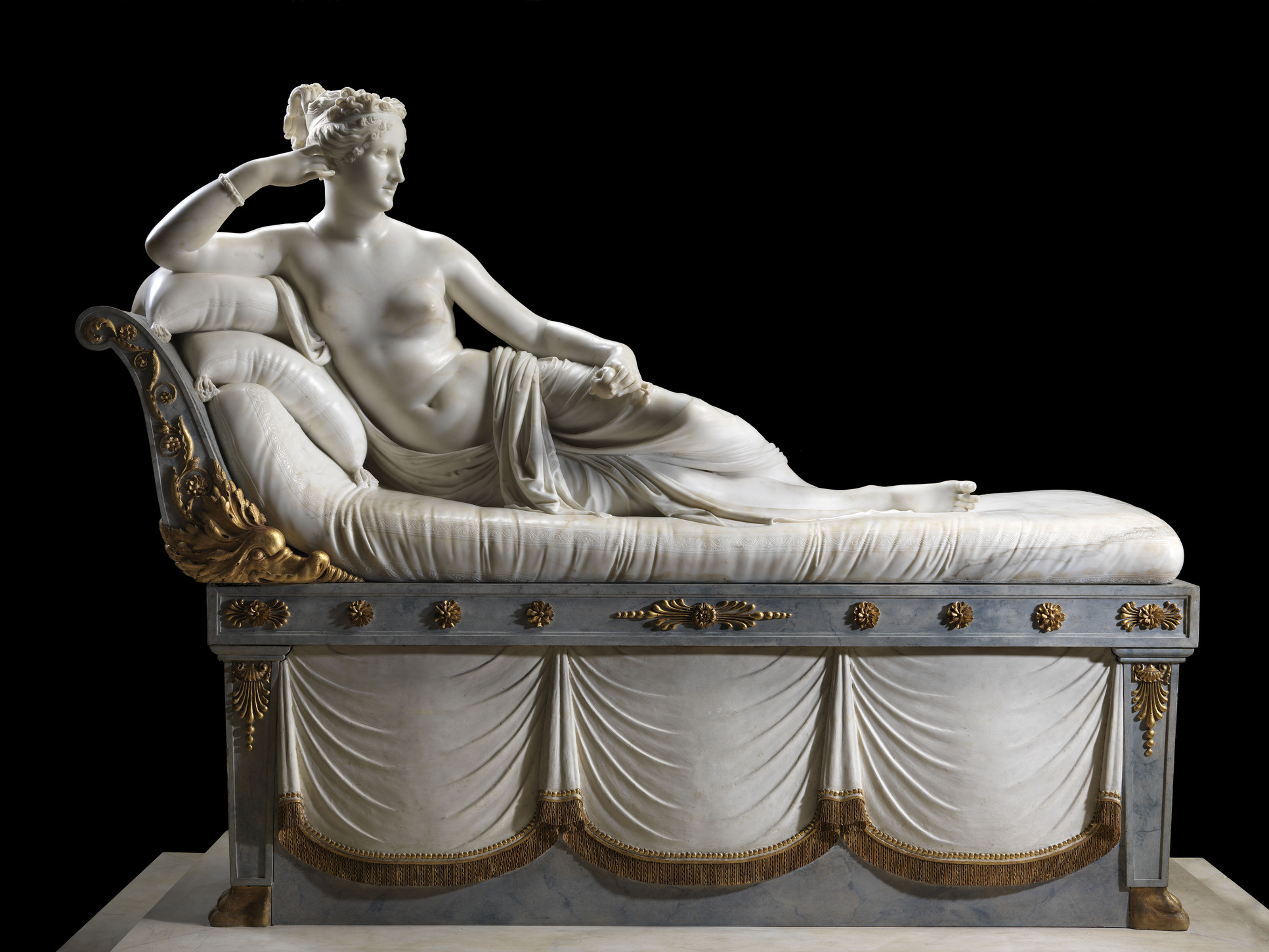
Depicted in the guise of Venus, Pauline Borghese Bonaparte (1780-1825) comfortably reclines on two pillows and a soft mattress, with her breasts uncovered and her hand supporting her head. Triumphant after the beauty contest adjudicated by the Trojan mortal Paris, she holds the prized apple in her left hand. According to the episode from Greek mythology, Paris awarded her a golden apple as a sign of her superior beauty, ranked against the goddesses Juno and Minerva. Commissioned by Prince Camillo Borghese, the sculpture was executed by the great artist Antonio Canova in Rome. He began work in 1804 and finished in 1808, when he appears to have been paid 6,000 scudi.
In 1803, Camillo Borghese married Pauline Bonaparte in Paris, France. The beautiful sister of Napoleon was already the widow of General Leclerc at 23 years old. The First Consul, who would become emperor a year later, was delighted to be related to a noble Roman family as important as the Borghese. Camillo married her less than a year after her first husband’s death, and together they moved to the Borghese Palace in Rome where Pauline could immerse herself in a life full of pomp and entertainment. Even though the marriage was not particularly happy, Camillo summoned the most distinguished artist of the day to sculpt his beautiful wife. Numerous rumors spread about the nudity of the sculpture and the possibility that the princess had posed undressed for the artist (she herself would mischievously state “Any veil can fall before Canova.”). Nevertheless, this is an idealized portrait, falling within the so-called “graceful” genre of Canova’s production. The princess’s recumbent pose on her fashionable, elegant, Empire-style settee, then known as an “agrippina,” refers to classical Etruscan and Roman figures lying on sarcophagi. It also recalls traditions from sixteenth-century Venetian painting, specifically Titian’s Venuses, with whom the sculpture competes in the Villa Borghese. Her settee also conceals a still-functioning mechanism that allows the artwork to turn 360 degrees.
As a final step, Canova took the water used as a coolant on his grinding wheel and poured it over the marble. The resulting pinkish sheen gave the stone a flesh-like hue. The rendering of the mattress is equally virtuosic, as it seems to sink softly under Paulina’s body. Such verisimilitude had an illustrious precedent in the mattress Bernini sculpted for Scipione Borghese’s Hermaphrodite. In the very years Canova was at work on Pauline, Bernini’s masterpiece was making its way to Paris, sold to Napoleon along with hundreds of other works. Canova, who had fiercely opposed the sale of the Borghese marbles, here recreated a neoclassical version.
Learn more:
https://www.collezionegalleriaborghese.it/en/opere/paolina-borghese-bonaparte-as-venus-victrix