

LEDA AND THE SWAN
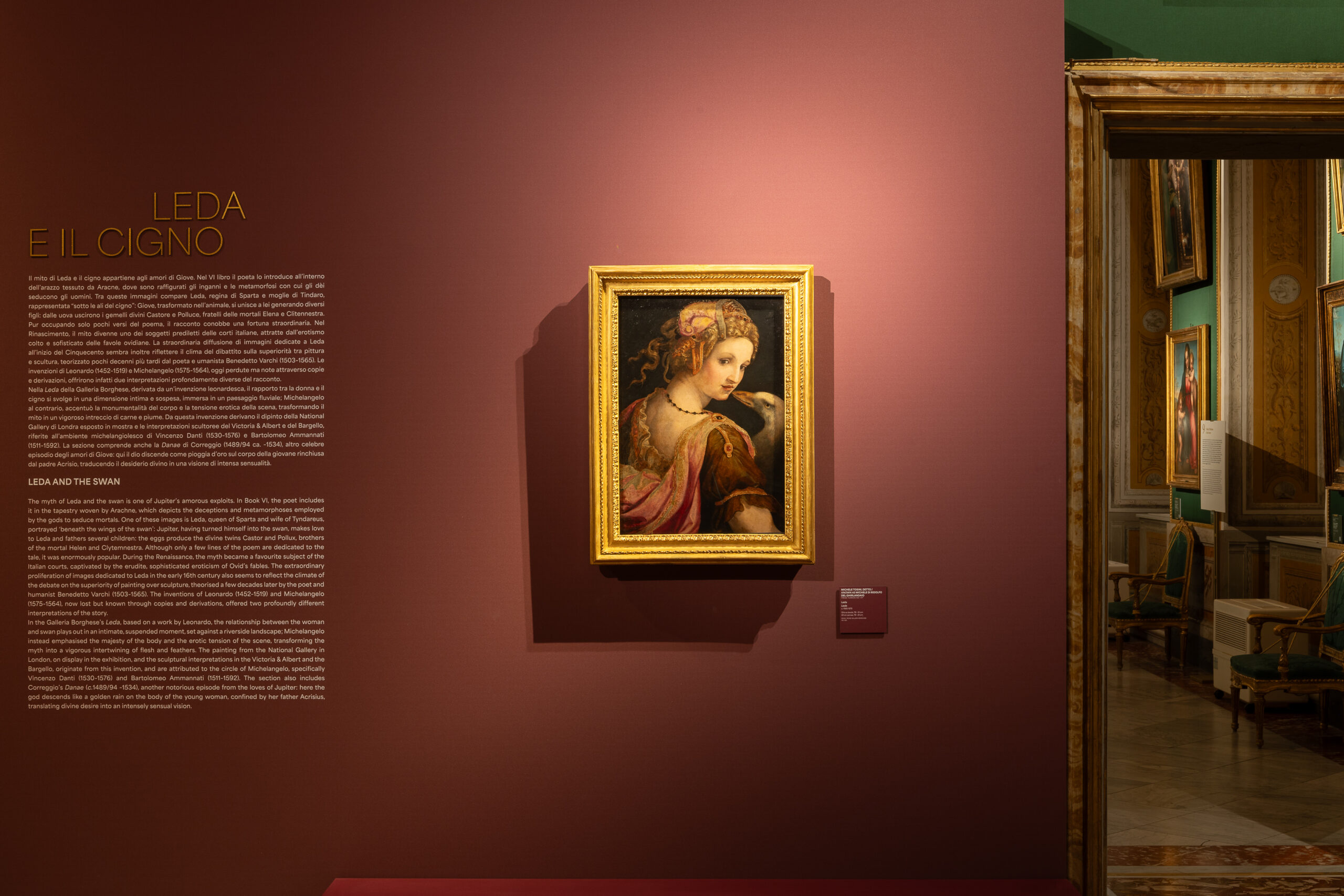
The myth of Leda and the swan is one of Jupiter’s amorous exploits. In Book VI, the poet includes it in the tapestry woven by Arachne, which depicts the deceptions and metamorphoses employed by the gods to seduce mortals. One of these images is Leda, queen of Sparta and wife of Tyndareus, portrayed ‘beneath the wings of the swan’: Jupiter, having turned himself into the swan, makes love to Leda and fathers several children: the eggs produce the divine twins Castor and Pollux, brothers of the mortal Helen and Clytemnestra. Although only a few lines of the poem are dedicated to the tale, it was enormously popular. During the Renaissance, the myth became a favourite subject of the Italian courts, captivated by the erudite, sophisticated eroticism of Ovid’s fables. The extraordinary proliferation of images dedicated to Leda in the early 16th century also seems to re ect the climate of the debate on the superiority of painting over sculpture, theorised a few decades later by the poet and humanist Benedetto Varchi (1503–1565). The inventions of Leonardo (1452–1519) and Michelangelo (1575–1564), now lost but known through copies and derivations, offered two profoundly different interpretations of the story.
In the Galleria Borghese’s Leda, based on a work by Leonardo, the relationship between the woman and swan plays out in an intimate, suspended moment, set against a riverside landscape; Michelangelo instead emphasised the majesty of the body and the erotic tension of the scene, transforming the myth into a vigorous intertwining of esh and feathers. The painting from the National Gallery in London, on display in the exhibition, and the sculptural interpretations in the Victoria & Albert and the Bargello, originate from this invention, and are attributed to the circle of Michelangelo, speci cally Vincenzo Danti (1530–1576) and Bartolomeo Ammannati (1511–1592). The section also includes Correggio’s Danae (c.1489/94 –1534), another notorious episode from the loves of Jupiter: here the god descends like a golden rain on the body of the young woman, con ned by her father Acrisius, translating divine desire into an intensely sensual vision.