
THE POET AND THE BOOK THE METAMORPHOSES IN THE TEXT AND THE PRIMUS AMOr OF APOLLO
Not only has Ovid’s Metamorphoses been an inexhaustible source of mythological tales, it has also been highly successful in terms of publications and interpretations. Since its reintroduction into the medieval school curriculum, the poem has undergone continuous literary and figurative ‘metamorphoses’: translations, vernacular adaptations and moralising interpretations that adapted the myth to new cultural, religious and social contexts.
In this sense, the poem Ovide moralisé, composed in France in the early 14th century, played a crucial role. It reinterpreted Ovid’s tales in the light of Christian morality, and populated them with knights and ladies in contemporary attire and biblical references.
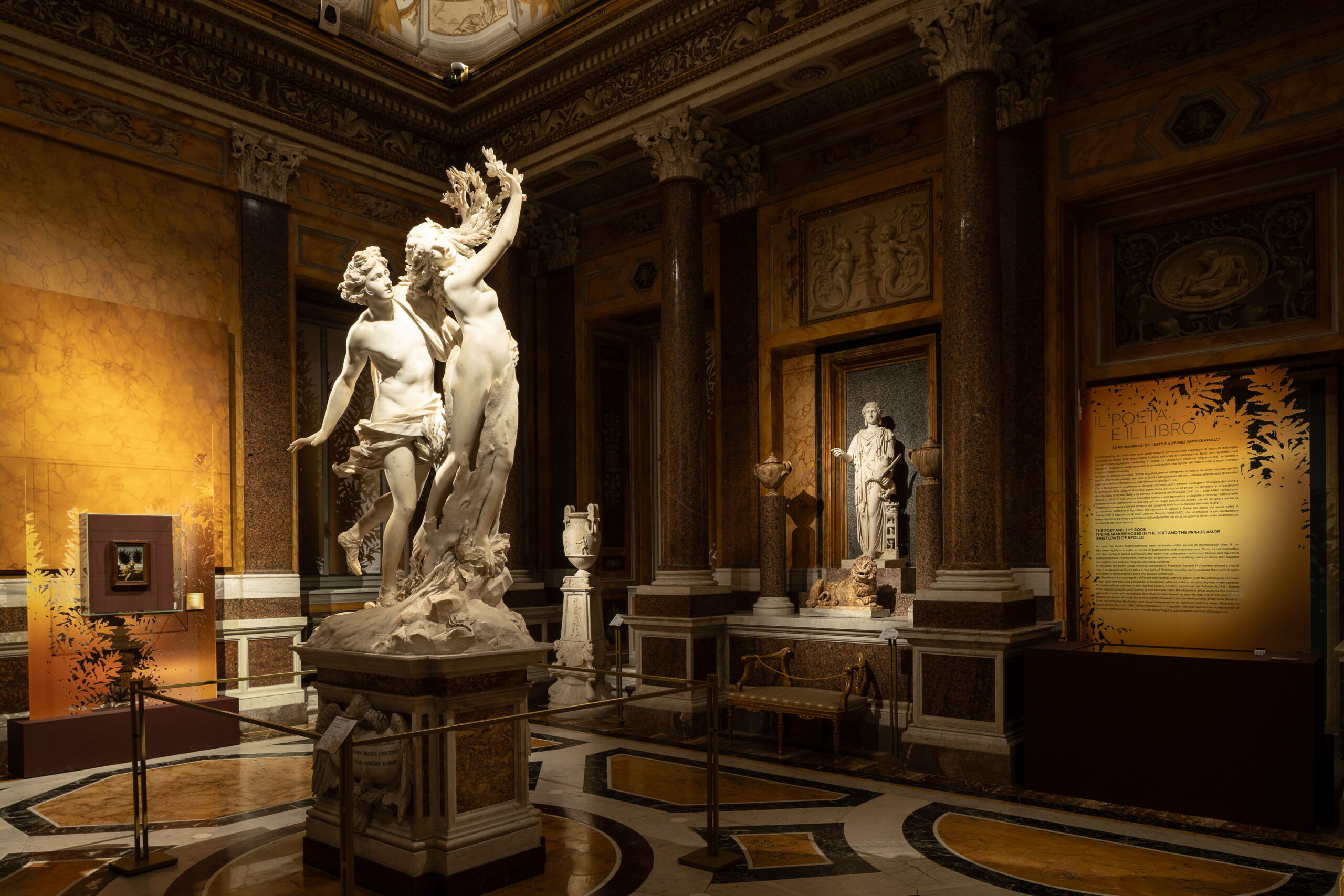
The Renaissance encouraged a different relationship with the poem: with the philological recovery of the Latin text and wide circulation of illustrated editions, a return to antiquity was made possible. The extraordinary painting in the National Gallery, London, by Piero del Pollaiolo (c.1441 – before 1496) depicting Apollo and Daphne, is one example. Here, the Florentine artist captures the moment of transformation with energetic, bold brushstrokes, breathing new life into one of the poet’s most famous narratives, although the style is still far removed from the classical form of the nude (Book I). Over the centuries, the literary and visual interpretations of Apollo and Daphne were influenced by Gian Lorenzo Bernini’s (1598–1680) masterpiece. It is arguably the most spectacular interpretation of the myth and the poem’s verse structure, becoming the quintessential symbol of Baroque art.