
THE MYTH OF PYGMALION: FALLING IN LOVE WITH STATUES
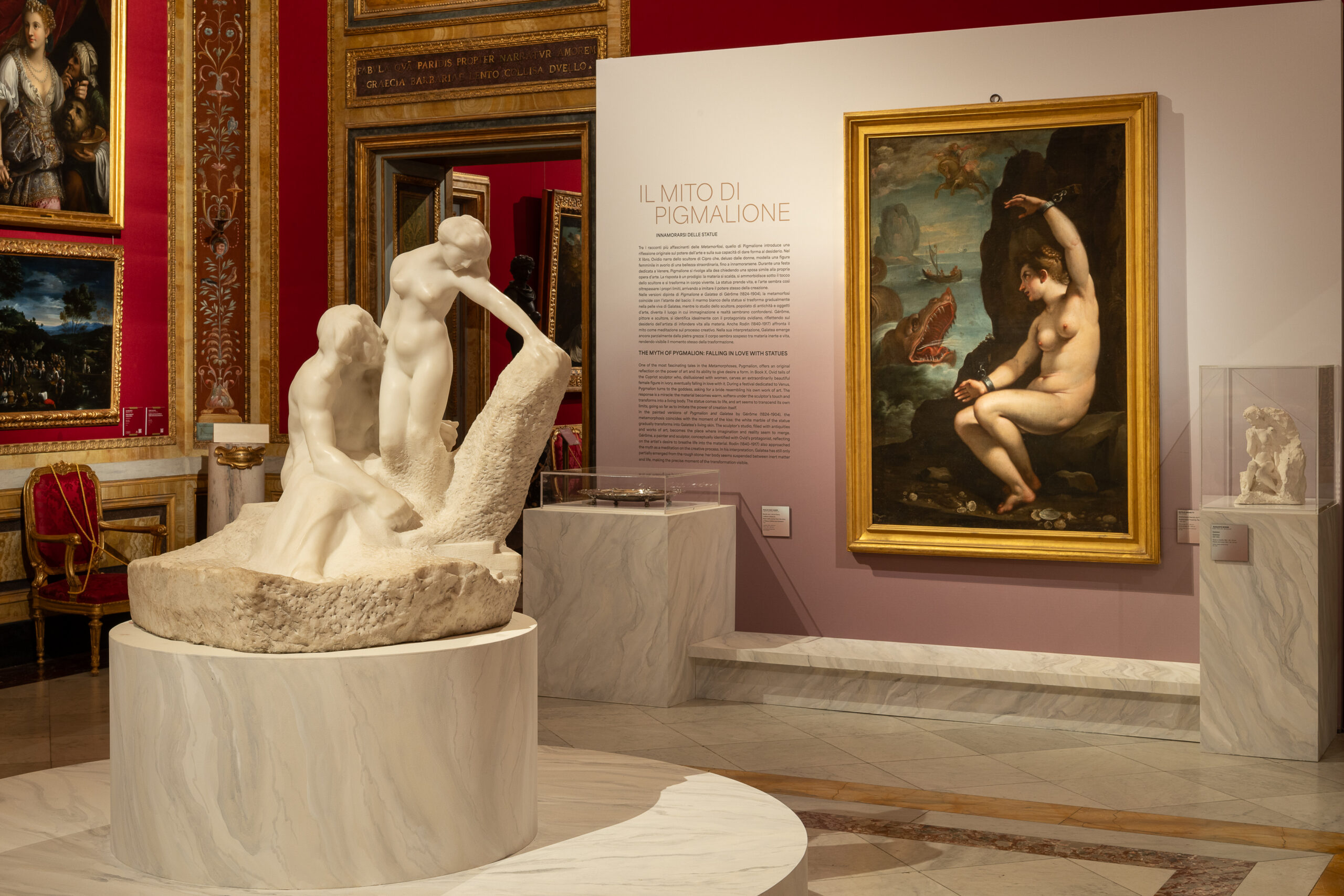
One of the most fascinating tales in the Metamorphoses, Pygmalion, offers an original re ection on the power of art and its ability to give desire a form. In Book X, Ovid tells of the Cypriot sculptor who, disillusioned with women, carves an extraordinarily beautiful female gure in ivory, eventually falling in love with it. During a festival dedicated to Venus, Pygmalion turns to the goddess, asking for a bride resembling his own work of art. The response is a miracle: the material becomes warm, softens under the sculptor’s touch and transforms into a living body. The statue comes to life, and art seems to transcend its own limits, going so far as to imitate the power of creation itself.
In the painted versions of Pygmalion and Galatea by Gérôme (1824–1904), the metamorphosis coincides with the moment of the kiss: the white marble of the statue gradually transforms into Galatea’s living skin. The sculptor’s studio, lled with antiquities and works of art, becomes the place where imagination and reality seem to merge. Gérôme, a painter and sculptor, conceptually identi ed with Ovid’s protagonist, re ecting on the artist’s desire to breathe life into the material. Rodin (1840–1917) also approached the myth as a meditation on the creative process. In his interpretation, Galatea has still only partially emerged from the rough stone: her body seems suspended between inert matter and life, making the precise moment of the transformation visible.