
BIOGRAPHY
Giovan Francesco Penni, nicknamed il Fattore, was born in Florence in the final decade of the fifteenth century; the date remains uncertain, ranging between 1488 and 1496 due to the lack of documentary evidence. He likely died in Naples around 1528, although some scholars suggest 1534. He is remembered as one of Raphael Sanzio’s most devoted pupils, to the extent that his artistic personality became deeply integrated with that of the master, making it difficult to identify his independent contributions.
It is believed that Penni met Raphael in Florence between 1504 and 1505, and later followed him to Rome around 1508, joining the major projects of the Apostolic Palaces. He participated in key Roman undertakings, including the Vatican Rooms and Loggias, the frescoes of the Farnesina, and the cartoons for the tapestries. However, the precise extent of his involvement in individual works cannot be definitively determined, partly due to the collaborative nature of Raphael’s workshop.
A central role of Penni was to translate the master’s inventions into graphic models for the workshop, refining and elaborating the initial ideas. This essential yet discreet function of design mediation explains the difficulty of confidently recognizing his hand within the great decorative projects of Rome.
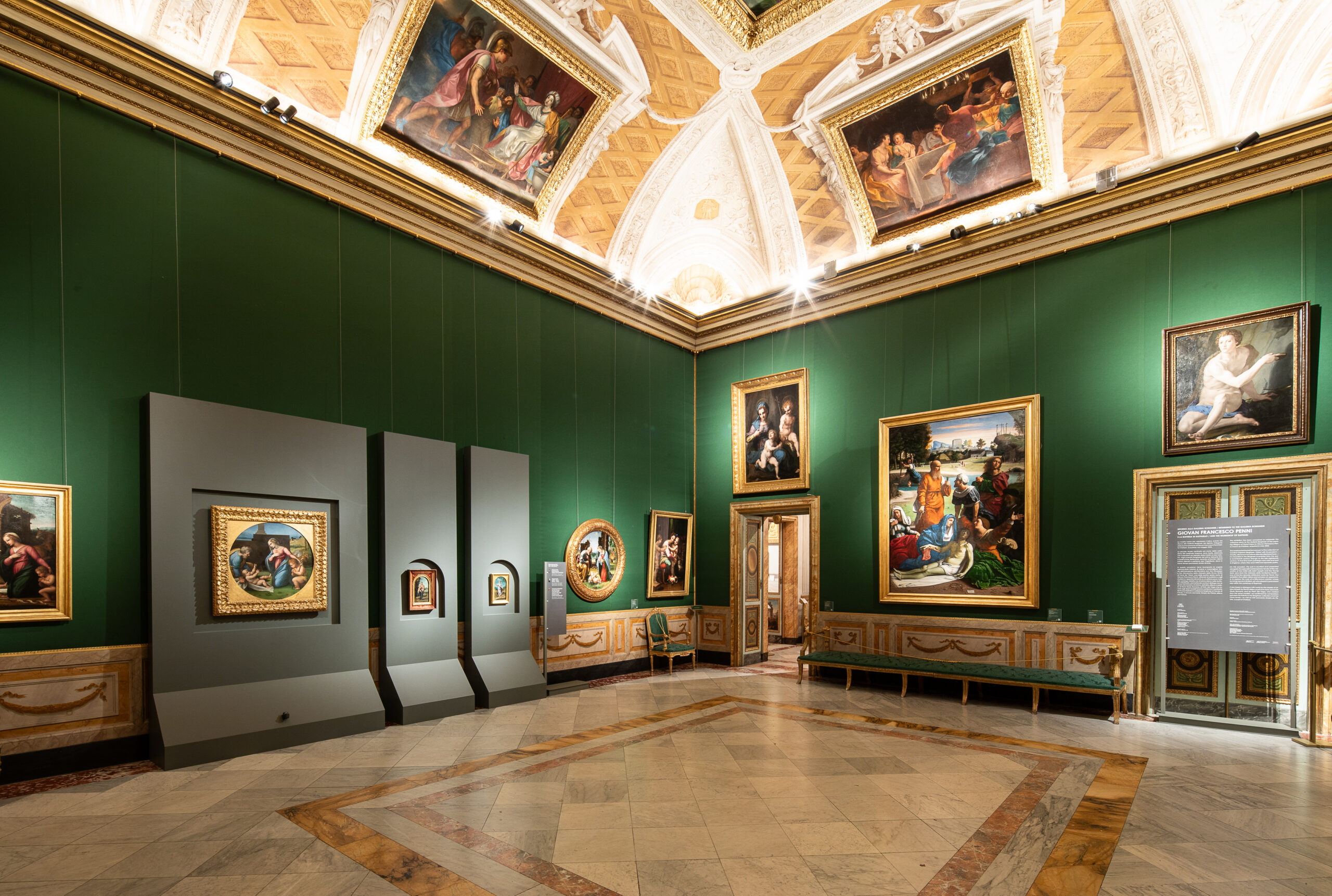
The body of works attributed to him with general scholarly agreement is limited. Among these are three works dating to the early second decade of the sixteenth century: the rounded panels Allegory of Good Hope (Bona Spes), preserved at the Galleria Borghese, and Allegory of Charity (Latona), in a private collection, as well as the tondo Nativity from the Abbey of the Most Holy Trinity in Cava de’ Tirreni.
Following Raphael’s death in April 1520, Penni inherited the workshop alongside Giulio Romano, taking responsibility for completing ongoing commissions, including the decoration of the Sala di Costantino and the Monteluce altarpiece. In 1524, he followed Giulio Romano to Mantua, called by Federico II Gonzaga, and later entered the service of Alfonso d’Avalos. After the Sack of Rome, he settled permanently in Naples, where he remained active until his death, dated between 1528 and 1534.