
BOOK PRESENTATION: CARAVAGGIO E IL MAESTRO DI HARTFORD. NATURA MORTA IN CASA BORGHESE AND IL TEATRO DELLA MUSICA DI LEONELLO SPADA
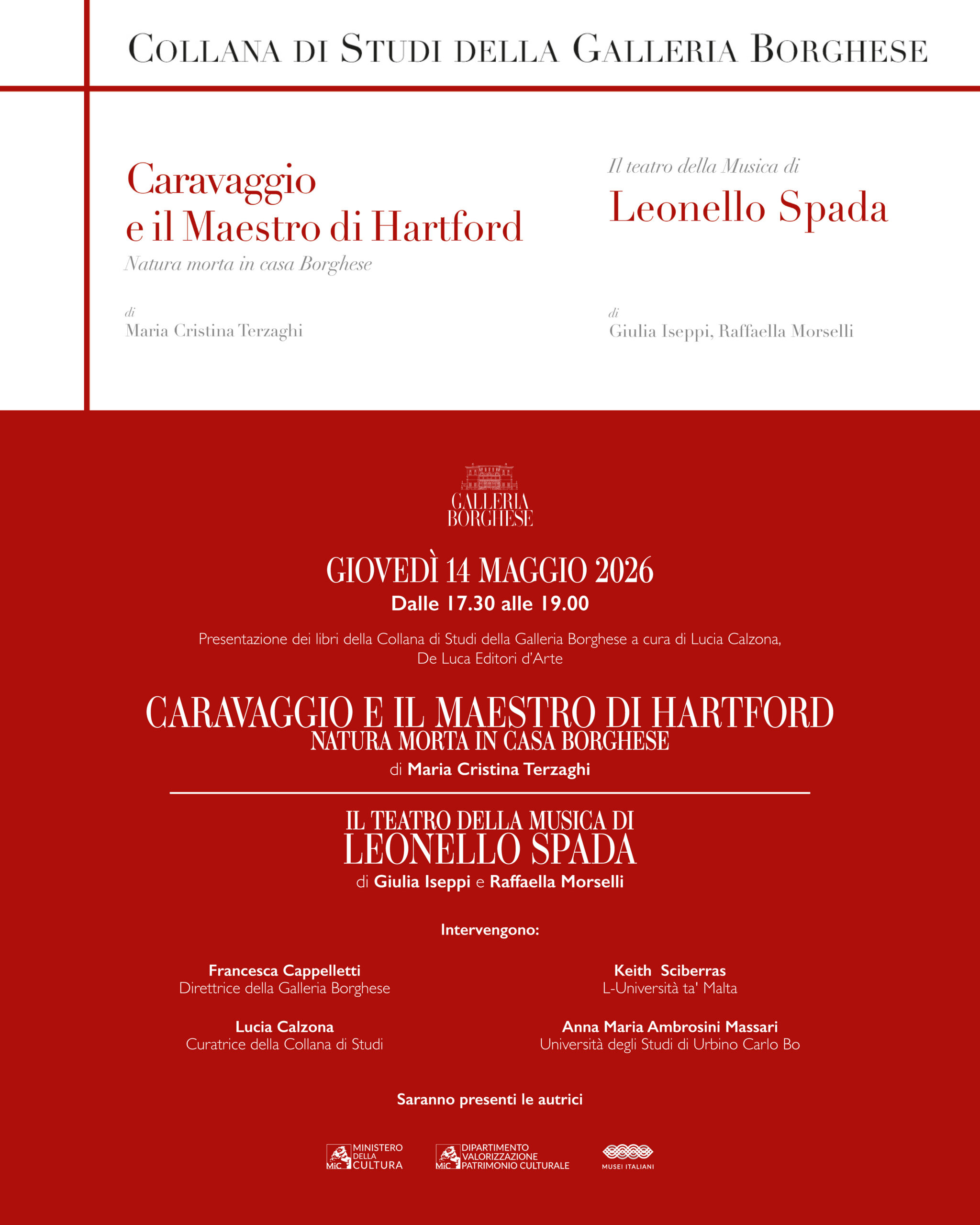
On May 14th, Keith Sciberras and Anna Maria Ambrosini Massari will present two new publications: Caravaggio e il Maestro di Hartford. Natura morta in casa Borghese, by Maria Cristina Terzaghi, and Il teatro della musica di Leonello Spada, by Giulia Iseppi and Raffaella Morselli.
This is a valuable opportunity to delve into central themes and protagonists of art history between the sixteenth and seventeenth centuries.
Caravaggio e il Maestro di Hartford. Natura morta in casa Borghese offers a journey to the origins of the Still Life genre, which is indissolubly linked to the artistic production of the workshops where Caravaggio took his first Roman steps, including the atelier of Cavalier d’Arpino. Within that fluid landscape of partnerships, friendships, and market demands lies the production of Naturalia paintings—one of the many fields in which the young Merisi provided a decisive and revolutionary contribution. The study illustrates how the execution of the Hartford group’s Still Lifes can be placed within the circuit of serial pictorial production, often shared among multiple artists, which also includes Caravaggio’s stunning Iuvenilia.
Il teatro della musica di Leonello Spada is a monographic study dedicated to one of the most iconic and complex themes in the work of Leonello Spada (Bologna, 1576 – Parma, 1622): the representation of musical scenes. Through an interdisciplinary analysis weaving together art history, musicology, and theater history, Morselli and Iseppi decode the visual language of an artist who successfully merged Caravaggio’s naturalistic lesson with the Bolognese scenographic tradition.
The so-called Concerto by Leonello Spada (Borghese Gallery, Rome) represents one of the most fascinating and, at the same time, enigmatic testimonies of early seventeenth-century Bolognese painting. Long attributed to Caravaggio and interpreted as a mere derivation of Caravaggesque naturalism, the painting is instead one of the most vivid examples of Bolognese painting from the beginning of the century. A closer analysis reveals that the work stands at the crossroads of multiple influences: the Carracci tradition, the academic taste for private concerts, and new musical forms intertwined with the sophisticated scholarly culture of Bologna.
This investigation intends to propose a reinterpretation of the Concerto through several levels, including the reconstruction of its provenance and critical reception, the precise analysis of instruments and iconographic details, its plausible dating, and finally the identification of three central figures. These figures are Ercole Bottrigari, a key figure in Bolognese and Emilian musical culture between the sixteenth and seventeenth centuries, the poet Giulio Cesare Croce, and the painter himself, a passionate experimenter poised between music, poetry, philosophy, and natural sciences. Indeed, Carlo Cesare Malvasia wrote of him that he possessed “a brain so lively, so brilliant, so witty, that he had few equals in his time.”
Participation in the event is free, and reservations are mandatory at this link