
CHAOS AND CREATION
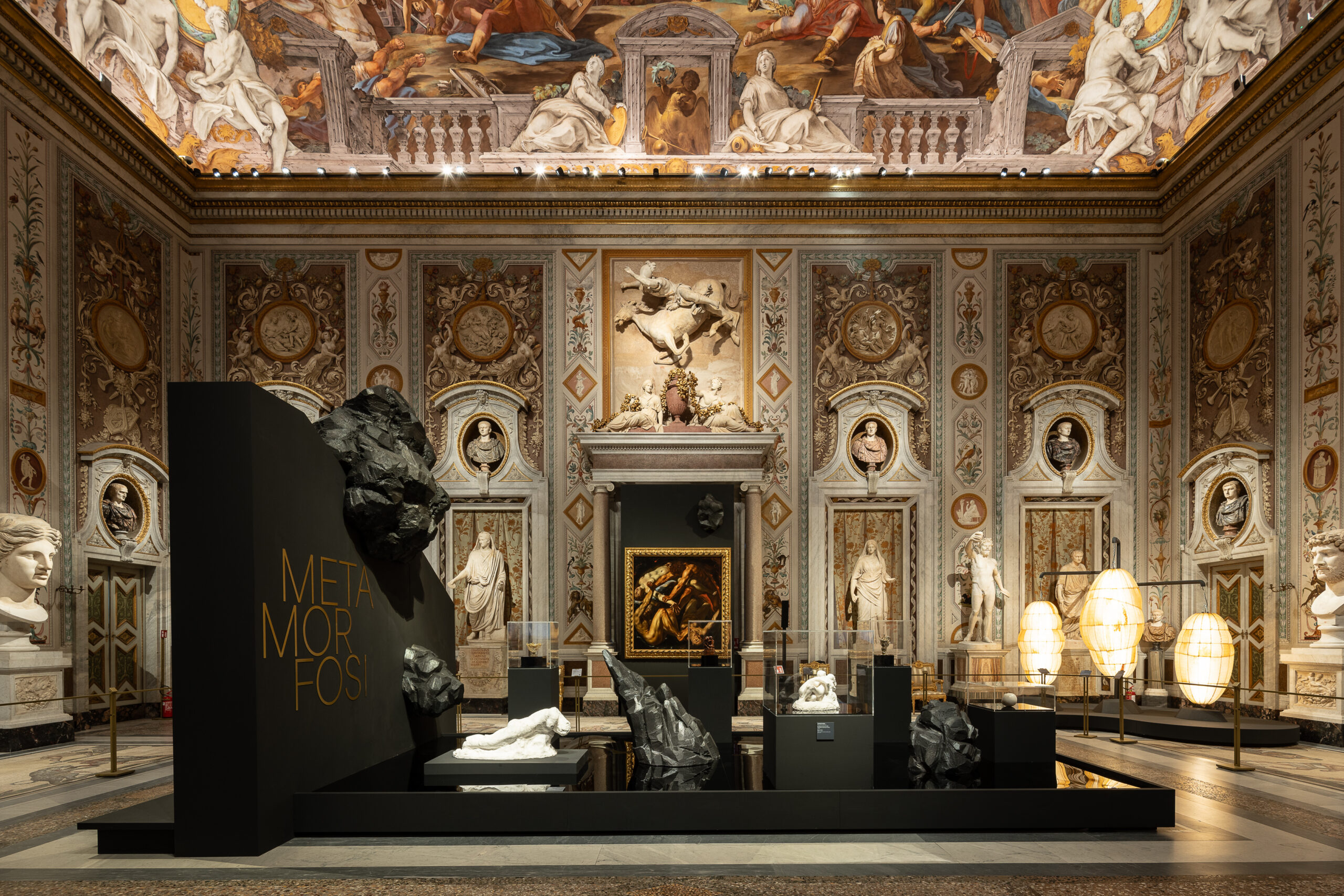
There is no better way to start the exhibition itinerary than with Ovid’s account of the creation of the world, that conceptual threshold visitors must cross to enter the Universe of the Metamorphoses. In the very first lines, the poet transforms the birth of the cosmos into images, giving a form to the transition from chaos to order and making metamorphosis the original principle that governs nature, the gods and mankind; in the works of art, this imagery takes on a concrete and tangible form, translating words into vision.
The primordial chaos – a formless orderless mass – is tamed by a mysterious deity who separates earth, water, air and fire, turning formless matter into something harmonious. This first metamorphosis shapes the sky, the seas, the mountains and forests, creating a world that, although orderly, is unstable and subject to constant change.
The works exhibited in this section convey the visual power of cosmogony. In Chaos or The Battle of the Four Elements by Louis Finson (1570/78–1617), the personifications of earth, water, air and fire are portrayed as intertwined bodies that form a vortex of energy and matter, evoking the primordial moment before the elements find their balance. The engraving by Hendrik Goltzius (1558–1617), showing the creation of the world, instead translates Ovid’s story into an ordered cosmic structure, where the separation of the elements coincides with the triumph of form over chaos.
The reference to traditional biblical themes is clear in Paradise by Herri met de Bles (c.1510–1566). Here the story from Genesis is interwoven with ancient cosmology, demonstrating the persistence of a shared imagery rooted in the concept of the world’s creation from formless matter.
The reflection on chaos and creation continues into the modern era with Auguste Rodin (1840–1917) and Constantin Brancusi (1876–1957). In Rodin’s The Earth, a figure seems to emerge slowly from the primordial mud, still suspended between birth and dissolution. In Brancusi’s Prometheus, the form is reduced to an ovoid essence, evoking both the origin of life and the creative act. In both works, metamorphosis is no longer merely a mythological tale, but a universal principle that governs nature, the body and matter.